Historical noteWritten for Viva-Almería in the mid-2000s. Prices, opening times and contact details are left out.
Classed by UNESCO as a Biosphere Reserve, it has been protected since 1987. It is volcanic in origin and land height ranges from 493m above sea level to 60m below. With an annual average rainfall of 100m.m, it is the driest place in Europe. Despite this, it supports a great variety of flora and fauna, adapted to the arid, salty environment.
South of the village of El Cabo de Gata, lies Las Salinas (salt lakes) where, in the first millennium B.C., the Phoenicians controlled the seawater, which entered through the marshes, in order to extract salt. Here, the Laguna de Rosa and the adjacent dunes are home to many species of migrant and breeding birds. The best known are the pink flamingos but over eight other species, including avocets, storks and eagles, can be sighted throughout the year, from spring through to autumn. Very few over-winter when the Salinas are drained after the autumn salt harvest.
For the rare, Italian wall lizard, with its green back with three rows of black spots, Spain – in particular this area – is its only habitat. The fox, hare and common grass snake are more common animals. Europe’s only native palm, the stunted dwarf fan palm, grows here, and the strange, yellow-flowered, parasitic plant, Cistande phelypaea, also flourishes.
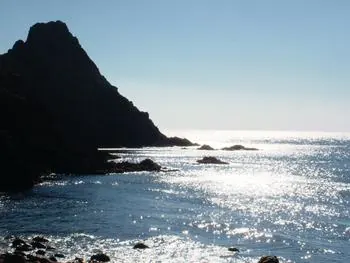
Cabo de Gata offers much to human visitors. The volcanic hills form dramatic cliffs and capes, the backdrop to beautiful, uncrowded beaches. Within the park and along the coast are scattered settlements of white-washed, flat roofed houses. It is possible to walk the 61km. from Retamar, round the southern tip of the cape, then north-east to Agua Amarga, although in summer, the lack of shade could make it uncomfortable
The village of San Miguel de Cabo de Gata, still supporting a small fishing fleet, is the main one on the western side of the promontory. Here, you will find a sandy beach and places to stay and eat.
Continuing south from the village, you will come to La Almadraba de Montelva, where salt from the salinas is piled in great heaps. Its church, with a very tall tower, dominates the area for miles around. The road then winds round rugged cliffs to reach the lighthouse (Faro de Cabo de Gata) on the southernmost tip of the cape.
A walking and cycling track, closed to cars, passes through prickly pear plantations to the fine, sandy beaches of Monsul (2km), the secluded Media Luna cove and Los Genoveses (4km) and to the resort of San José (8.5km).
The road continues north over cliffs, along the coast, past Los Escullos and La Isleta, then turns inward before descending to a pleasant valley. Four kilometres on is the desert hamlet of Rodalquilar, once a small mining settlement, amid scrub, palms and cactuses.
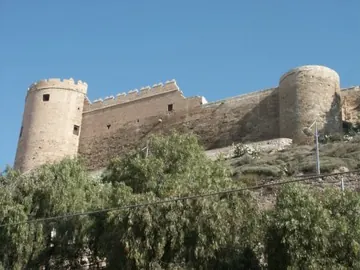
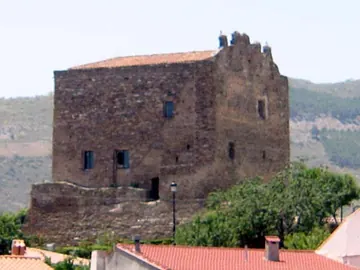
No road follows the cliff-lined, most secluded stretch of the coastline from Las Negras to Agua Amarga. For walkers, it is an 11km. up and down path. One hour’s walk from Las Negras takes you to the site of a ruined hamlet, whose buildings included a castle and which more recently was an international hippy colony. In a further hour and a half, you will reach Cala del Plomo, where there is a beach and a tiny settlement. The path continues to Agua Amarga, the northernmost settlement on the east side of Cabo de Gata.
A further 3km. up the Carboneras road, a turning leads to a cliff-top lighthouse (Faro de la Mesa Roldan) and an old watchtower. From here there are more wonderful views.
At the time of writing · mid-2000s · 7 notes
- As well as tourist information and maps, it has displays of local flora, fauna and human activities, souvenirs and craft work.
- The bank on Calle Iglesia has ATM.
- Horses can be hired for exploring the park from Hotel Cotijo El Sortillo, an 18th century ranch house, converted to a 4 star hotel, south out of San José.
- Hotel Rodalquilar, with amenities including restaurant, pool, sauna and gym, has rooms arranged around a sunken courtyard.
- On the east side of the village is a good-value restaurant, down a signed track.
- This pleasant fishing village, with its sandy beach, now caters for holiday-makers and has a supermarket, post office, several restaurants and hotels.
- From the car park, you can walk down to the naturist Playa de los Muertos.
About this page
Text and photograph from the original Viva-Almería guide to Cabo de Gata Natural Park, written in the mid-2000s. Edited for this site: 9 sentences with prices, opening times, contact or business details removed; details about shops and services moved to “At the time of writing”.
Earlier address: /Cabo_de_Gata_Natural_Park_P655.html