Historical noteWritten for Viva-Almería in the mid-2000s. Prices, opening times and contact details are left out.
The very name of the town Alhama comes from “alhamman” which means thermal baths. Although the town was founded at an earlier date the main influence on it was during the centuries that the Arabs lived there. When Almería was under the rule of Abd-al-Rahman III, he expanded on some towns and founded others in this strategically sited valley behind the coastal port he needed to protect.
The roads in the region have been greatly improved in recent years and it is a very easy drive from the coast and seems incredible that the scenery can change so much in such a short time. From the arid desert behind Almería the route swings left into this beautiful, fertile valley where the rivers Nacimiento and Andarax meet and then leads you to the stunning Alpujarras
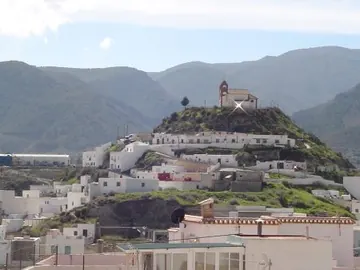
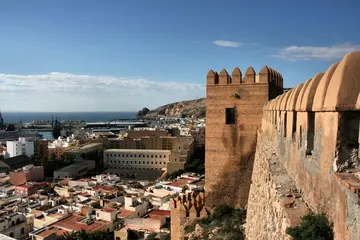
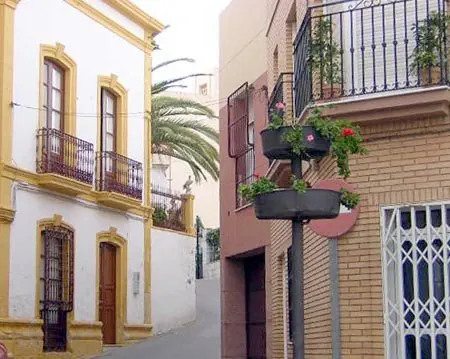
The Moorish influence is obvious in the town, in the features of its streets, in the remains of the defensive fortress which occupies a promontory about 50 metres from the edge of the old houses of the town, and of course in the thermal baths.
Another reason to stay here is the proximity of the Chalcolithic archaeological site of Los Millares, just 4 km away. It was discovered in 1891 when the Almería-Linares railway line was being constructed. Los Millares was a fortified settlement dating from 2700 BC and is well worth a visit to see the excavations and so interesting to realise that the climate was different then. There were forests that sheltered deer and wild boar and the river was navigable up from the sea and was used to bring the copper ore down from the Sierra de Gádor.
When the Moors were expelled from Spain in the 15th century, the area became a feudal estate under the control of Gutierre de Cárdenas, a relation of King Ferdinand and whom he had assisted in the war of Granada. The chronicles of these events are carefully conserved in the parochial archives and allow the present generation to know the history of the town.
Alhama is one of the five main towns of the province in the cultivation of the vine, which can be seen growing up the slopes and the resulting wine is evidence of the determination of the farmers to cultivate every fertile square foot of land, however high or hard to reach.
The local holidays take place between 6th and 8th Decemer in honour of Saint Nicholas of Bari and the Immaculate Conception. The summer fiestas of the town are celebrated from 22nd to 25th July, and other minor fiestas are held in honour of Saint Marcos, May Day, Saint Antonio, Saint Juan and the Virgen of the River.Also worth seeing are the typically alhameñan fiestas on Resurrection Sunday The town follows the tradition of having big Nativity Scenes before Christmas.
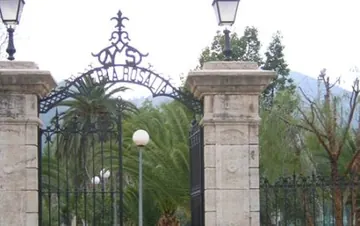
Places to see on the outskirts of the town include the “Park of Rosalía”, the “Waterfall” The “ Nicholas Salmerón Walk”, la Plaza de España and the viewing points “Valle de Andarax” and the “Balcony of the seven towns”. There are a variety of walks in the Sierra de Alhama, some are worth doing for their historic interest and others simply to enjoy the beautiful countryside of Almería.
About this page
Text and photograph from the original Viva-Almería guide to Alhama de Almería, written in the mid-2000s. Edited for this site: Spanish accents restored in place names; 1 sentence with prices, opening times, contact or business details removed.
Earlier address: /alhama_de_almeria_p3200.html